Afghan Canadians Rally in Toronto to Condemn Pakistan’s Airstrikes
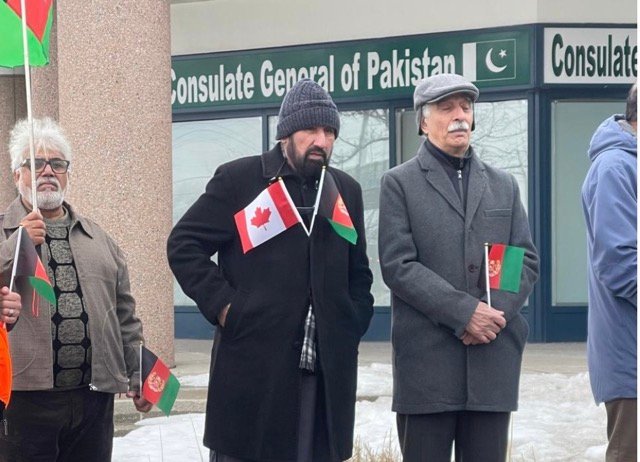
Photo: @کاناډا کې افغان ليکوالو ستراتيژيک مرکز
By Wakeel Attock
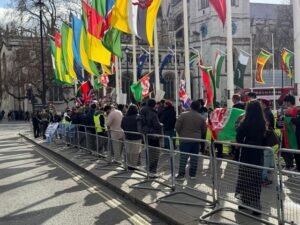
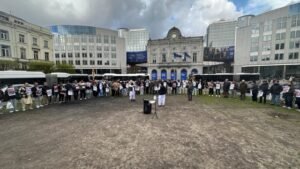
Dozens of Afghan Canadians gathered outside the Pakistani Consulate in Toronto on March 3, 2026, condemning Pakistan’s airstrikes inside Afghanistan and urging the international community to intervene.
The demonstration, one of the largest Afghan diaspora mobilizations in the city in recent years, followed weeks of rising tensions between Pakistan and the Taliban authorities, including deadly cross-border strikes and retaliatory operations.
According to recent reporting by the Afghan Diaspora Network, the confrontation intensified after Pakistan launched airstrikes in eastern Afghanistan, claiming to target militant groups. Taliban forces responded with counter-operations along the Durand Line. This cycle of escalation has deepened fears among Afghans worldwide that the conflict could widen and further destabilize an already fragile region.
Waving Afghan flags and chanting slogans, protesters said the cross-border attacks have killed civilians and violated Afghanistan’s sovereignty. For many in the crowd, community leaders, activists, former officials, and families, the rally was both a political protest and a deeply personal response to violence affecting relatives and communities back home.
“We are in fire for five decades,” one demonstrator said, describing the long history of conflict Afghans associate with Pakistan’s involvement.
“Because of the brutal and oppressor neighbor, we Afghans have not lived in peace. If in the world anyone asks who can hire someone to kill, Pakistan is ready.”
Another protester condemned what he called Pakistan’s “ground and air invasion,” urging global institutions to take notice.
“We want to bring the attention of the global community to the atrocity of Pakistan in Afghanistan,” he said.
For many participants, the demonstration was not about supporting any political faction but about defending Afghanistan’s sovereignty.
“Pakistan must know that Afghans, whoever they are, will defend Afghanistan and its people,” a speaker said. “We are not defending the current ruler of Afghanistan. I have not been able to sleep because my people in Afghanistan are dying under the fire of Pakistan.”
He also rejected attempts to divide Afghans along ethnic lines.
“How can the Afghan diaspora be happy when Pakistan hits a Pashtun province and says it is not a Tajik province? We tell the world that Afghans are united.”
The Resolution: “No Afghan Will Remain Silent”
A central moment of the rally came when community representative Mursal Darwish read a formal resolution on behalf of the Afghan diaspora in Canada.
“We gather with heavy hearts but with strong voices to speak for justice, sovereignty, and the protection of innocent lives,” she began.
The resolution condemned Pakistan’s airstrikes on Kabul, Nangarhar, Khost, and Paktika, strikes that began in October 2025 and continued into February 2026.
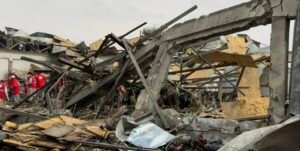
“These actions are in clear violation of international norms and the principles of good neighborliness,” Darwish read. “They have caused significant material destruction and heavy civilian casualties, including women and children.”
The reference to “international norms” carries particular weight in the current geopolitical climate. With the ongoing US–Israel–Iran war reshaping regional alliances and weakening long-standing diplomatic frameworks, violations of sovereignty have become more frequent and less constrained by global institutions.
The erosion of international rules has created an environment in which smaller nations, especially conflict-affected ones like Afghanistan, are increasingly vulnerable to cross-border aggression. In this broader context, Pakistan’s strikes are seen not only as a bilateral dispute but also as part of a wider pattern of states testing the limits of weakened global oversight.
The resolution called on the United Nations, the European Union, the Organization of Islamic Cooperation, and the Canadian government to take “practical and effective measures” to prevent further attacks. It also urged the activation of monitoring and accountability mechanisms to investigate what it described as “war crimes.”
“No Afghan will remain silent when their nation’s sovereignty is violated,” Darwish said. “Attacks on residential homes, on women, on children constitute war crimes. Those responsible must be held accountable under international law.”
The resolution also urged Pakistan to end “all direct and indirect interference in Afghanistan’s internal affairs” and called for disputes to be resolved through diplomacy and international mediation.
“The political system and the future of Afghanistan must be determined solely by the free will of the Afghan people,” it stated.
Voices of Defiance and a Call for Unity
A former Afghan government official urged Afghans worldwide to mobilize.
“We ask all Afghan diaspora communities to demonstrate in every country they are residing,” he said. “Pakistan has oppressed Afghans for five decades. Afghans will never allow foreign invaders to interfere.”
He addressed Pakistan’s military leadership directly:
“Asim Munir, as you lost the war against India, you will lose the war against Afghanistan too. Remember that.”
He also criticized Pakistani officials, including Khawaja Mohammad Asif – Defence Minister of Pakistan, who had claimed that Pakistan had shown generosity toward Afghan refugees.
“They gave us a place for 40 years. It was you who brought fighting to Afghanistan. It was you who destroyed our army and divided us.”
He ended with a call for unity:
“If there is any attack on anywhere in Afghanistan, this is an attack on all Afghanistan. We need to be united.”
Among the most powerful speeches was that of Afghan poet and political commentator Esmat Qani.
“Afghanistan is under aggression, under direct invasion,” he said. “An aggression that Pakistan has been paid for in the international market – a rented thug, a rented killer has been paid for killing.”
Qani argued that Pakistan’s destabilizing role in the region is longstanding.
“Since the creation of Pakistan, it has had bad relations with India, with Iran, with Afghanistan,” he said.
“Pakistan is involved in the fighting and killing of Baloch and Pashtun people. Pakistan is acting as a rented state against the region.”
He called on the international community to recognize that “peace and security in this region is tied to peace and security of the world,” urging global pressure on Pakistan to end its interference.
He also addressed the people of Pakistan directly:
“People of Pakistan should take their destiny in their own hands. Baloch do not want to be part of Pakistan, Pashtuns do not want to be part of Pakistan.”
Qani ended with a call for solidarity among oppressed groups:
“We want unity among all these people against a state that destabilizes the region.”
As the demonstration concluded, participants emphasized that the rally was only the beginning of a broader movement. Many said they plan to continue organizing, lobbying, and raising awareness until international institutions take action.
For Afghan Canadians, the rally was not just political; it was a collective expression of grief, identity, and responsibility.
“We do not beg,” one demonstrator said. “We tell the world that Afghans are united.”
Afghan poet Wakeel Attock previously served as the director of culture for the eastern provinces of Laghman and Nooristan.
Note: The contents of the article are of sole responsibility of the author. Afghan Diaspora Network will not be responsible for any inaccurate or incorrect statement in the articles.