Erased, But Not Gone: The Afghan Women Who Stayed
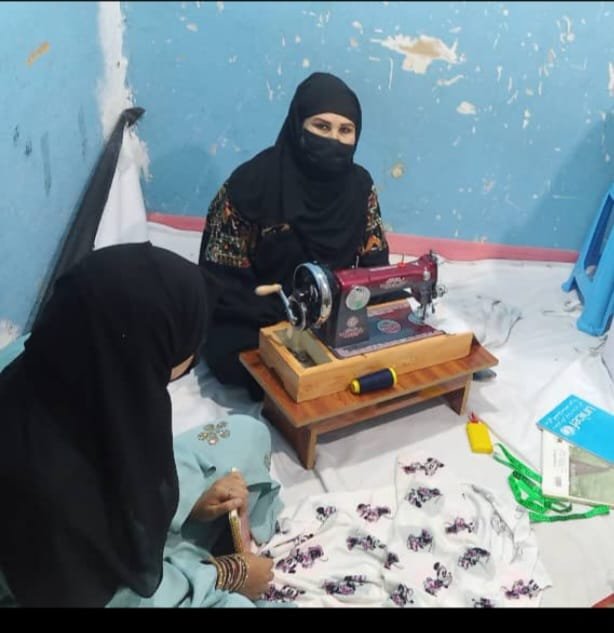
Photo: @Qanari Training and Production Company
By SS Ahmad
The Taliban knew her name, her rank, and exactly where to find her. When they called Latifa Arif four months after seizing her city, it wasn’t to punish her, but to offer her a job. The former lieutenant could return to the police headquarters she once called her own-on one condition: that she accept a regime built on erasing everything she had fought for. She refused.
When 28-year-old Latifa Arif speaks about her past, she does so with the calm precision of someone trained to serve. A graduate of political science, a former police officer, a human‑rights worker, and a journalist, she represents a generation of Afghan women who built their futures with discipline and hope – only to watch them collapse overnight.
Latifa grew up in an Afghanistan where education was possible and ambition was not a crime. She completed her studies at Mawlana Private University in 2019. For seven years, she worked across human rights, children’s rights, family rights, women’s rights, teaching, and management within police force in northern Mazar-e Sharif. She believed in service, in progress, in the idea that Afghanistan could belong to all its citizens.
In 2015, she received a life‑changing opportunity: military police training in Türkiya. She was one of 365 Afghan trainees sent to a Military Academy in Türkiya. For six months, she trained rigorously, learning discipline, leadership, and the responsibilities of national service. When she returned, she joined the Ministry of Interior in Balkh province as a second Saran (lieutenant). She had earned her place without political connections – something she still takes pride in.
But the Afghanistan she served did not survive.
On the night Mazar‑e Sharif fell to the Taliban, Latifa was at home. She never returned to her office again. Four months later, the new Taliban‑run police headquarters called her, inviting her to resume her job. They knew her name, her background, her rank. But the conditions were clear: only women over 40, accompanied by a male guardian, could serve. Latifa was 24, unmarried, and ideologically incompatible with the new regime.
“My work was in human rights and women’s rights,” she says. “How could I work for a system that does not recognize either?”
The fall of the republic shattered her expectations. “All my hopes were smashed,” she says. “As a woman, as a member of society, as a human being.”
The collapse also took her father. He had been ill, but the stress of watching all his children – especially his daughters – lose their jobs and futures weighed heavily on him. Latifa was in Kabul when he died in Mazar-e Sharif. Because of security concerns, she could not attend his funeral. “This is a wound I will never forget,” she says crying.
Her life had already been marked by violence. In 2017, she was injured in a suicide bombing in central Kabul. She survived, but the memory remains etched into her body and her story.
Today, she lives in Mazar‑e Sharif with her mother, siblings, and her fiancé’s family. She is engaged but not yet married. She feels the pressure of a society that sees her differently now. “When the Islamic Emirate came, people treated me as if they knew me,” she says. “I had been a public figure. That became dangerous.”
She cut ties with colleagues, especially women. She hid. She waited. She refused to leave Afghanistan, despite family pressure. She registered once for a German evacuation program, but she never wanted to go. “I stayed in difficult times before,” she says. “I will stay now.”
Latifa’s story is one of loss, but also of refusal – refusal to disappear, refusal to surrender her identity, refusal to abandon the country she still calls home.
SS Ahmad is a freelance researcher and journalist based in, Kabul Afghanistan.
Note: The contents of the article are of sole responsibility of the author. Afghan Diaspora Network will not be responsible for any inaccurate or incorrect statement in the articles.