Afghan Women Stitch Survival and Hope Under Taliban Rule
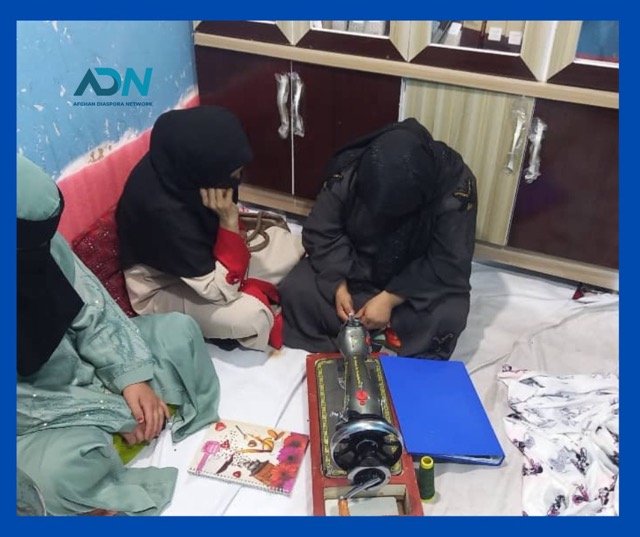
Photo: @Qanari Training and Production Company
By SS Ahmad
When the Taliban barred women from universities in 2022, they didn’t just close classroom doors, they sealed the fate of a generation.
Like for many women, for Latifa Arif, the announcement felt like the final wall closing in. She had already lost her military career after the Taliban’s return to power. She had mourned her father. She had adjusted to a life narrowed by fear and uncertainty.
Then, overnight, her younger sister, like millions of Afghan girls, was shut out of education.
But rather than let the rubble bury her hope, she gathered the women of Kabul and began to stitch it back together, one thread at a time.
“Nothing can replace education,” Latifa says. “But I needed to create hope.”
Her story unfolds against a stark national backdrop. Since the Taliban reclaimed control in August 2021, Afghan women have faced one of the most sweeping reversals of rights in modern history.
Secondary schools for girls remain closed across most of the country. Universities are off-limits to women. Many forms of employment have been restricted or banned. Women have been removed from public offices, barred from working with most nongovernmental organizations, and subjected to strict dress codes and limits on movement.
Beauty salons, one of the last women-run sectors of small businesses, were ordered shut in 2023. Even parks and public baths were declared off-limits.
These policies have reshaped not only public life, but private survival for women. In a country already battered by economic collapse, drought, sanctions and humanitarian crisis, removing women from education and employment has deepened household poverty.
According to international organizations, Afghanistan faces one of the world’s largest humanitarian emergencies, with millions dependent on aid. In such conditions, excluding half the population from economic participation is not only discriminatory it is also economically devastating.
When the doors closed, they picked up needles and thread
Latifa knows that reality intimately. After losing her job, she found herself without income, unable even to afford phone credit. But long before she wore a police uniform, she had learned embroidery and tailoring as a teenager. Those skills were once cultural inheritance. Now they have become tools of survival.
From that necessity emerged an idea: Qanari Training and Production Company that produces traditional Afghan clothes for women.
Latifa began drafting proposals and seeking support. She formally registered Qanari in Kabul and in the northern city of Mazar-e Sharif. She reached out to women, former students, widows, girls expelled from school. The aim was simple but radical in its context: to create a space where women could gather, learn and earn.
“Our work is all by hand,” she explains. “Uzbeki, Hazaragi, Gand-e Afghani clothes, cultural dresses, anything connected to our heritage.”
In a country where women’s public visibility is shrinking, cultural production has become a subtle form of presence. Traditional embroidery carries ethnic identity, memory and pride.
By training women in these crafts, Qanari does more than teach income-generating skills; it preserves fragments of Afghanistan’s pluralistic heritage at a time when cultural expression feels increasingly narrow.
The company’s goals are both economic and symbolic: to preserve Afghan ethnic clothing and export it abroad, and to enable women to achieve financial independence after completing their training.
The symbolism matters. Under Taliban rule, the official narrative emphasizes women’s domestic roles. Qanari works within cultural boundaries — tailoring, embroidery, heritage clothing — yet quietly challenges economic confinement. Each stitch becomes an act of agency.
Symbolism does not pay rent
Qanari has showcased its products in Kabul and Mazar-e Sharif. Audiences admire the craftsmanship. Orders come in, but fulfilling them is another matter. Without industrial sewing machines, production remains slow. Without funding, there is no stable workspace. Trainers work voluntarily, without salaries.
“We need a place,” Latifa says. “We need machines. We need salaries for trainers. We need a budget. If we have these, we can stand on our feet.”
Her words reflect a broader pattern across Afghanistan: women’s resilience is abundant; structural support is scarce. Small home-based enterprises, sewing circles, handicrafts, and informal tutoring have multiplied as women adapt to restrictions.
Yet these initiatives operate in legal grey zones, vulnerable to shifting policies and economic fragility. International aid agencies, constrained by Taliban regulations, struggle to balance humanitarian assistance with commitments to gender equality. The result is a patchwork of survival strategies rather than sustainable development.
Latifa dreams of expanding Qanari to at least 14 provinces, including Panjshir, where widows are numerous and economic options are few. Decades of war have left Afghanistan with one of the highest numbers of war widows in the world. For many, handicraft production may be the only accessible livelihood under current restrictions.
“Empowered women means empowered families,” she says. “And empowered families build an empowered society.”
Her words echo a broad body of development research: women’s income is closely linked to improved household nutrition, education and health outcomes. Excluding women from the workforce does not simply marginalize individuals; it constrains national recovery.
Afghan women need support
Latifa does not romanticize Afghanistan’s recent past. “The republic had problems. The Taliban have problems,” she says. Her preference is “a real Afghanistan, prosperous, equal, peaceful.” It is a careful formulation, reflecting both political fatigue and aspiration. Many Afghans share this ambivalence: disappointment with corruption and inequality under the former republic, coupled with deep alarm at the current rollback of rights.
Her vision remains grounded in education. She wants universities reopened for girls and boys alike. She wants employment pathways restored. She wants women to feel visible, not erased.
For now, Qanari operates as a microcosm of what Afghan women continue to do quietly across the country: adapt, create, endure. In workshops pieced together through borrowed space and volunteer labor, women gather not only to sew but to speak, to exchange news, worries and fragments of encouragement. In a society where public assembly for women is increasingly restricted, such spaces become social lifelines.
Latifa’s final message is directed outward, to Afghan women in the diaspora.
“One last time,” she says, “I want to say: Afghan women inside Afghanistan need the support of Afghan women outside. Their support will empower us. It will help us stand on our feet. This is our duty, to support each other in times of need.”
The call underscores an emerging transnational dimension of Afghan women’s resistance. Diaspora networks have amplified voices, provided funding and lobbied internationally. Yet the gap between visibility abroad and constraint at home remains stark. Initiatives like Qanari attempt to bridge that divide, translating solidarity into tangible opportunity.
Qanari is more than a company. It is a modest economic project rooted in cultural continuity. It is a survival strategy in an economy where women are systematically sidelined. It is also a quiet rebuttal to erasure.
SS Ahmad is a freelance researcher and journalist based in Kabul, Afghanistan.
Note: The contents of the article are the sole responsibility of the author. Afghan Diaspora Network will not be responsible for any inaccurate statements in the articles.