A Province in Darkness: Enforced Disappearances Surge as Fear Deepens in Balochistan
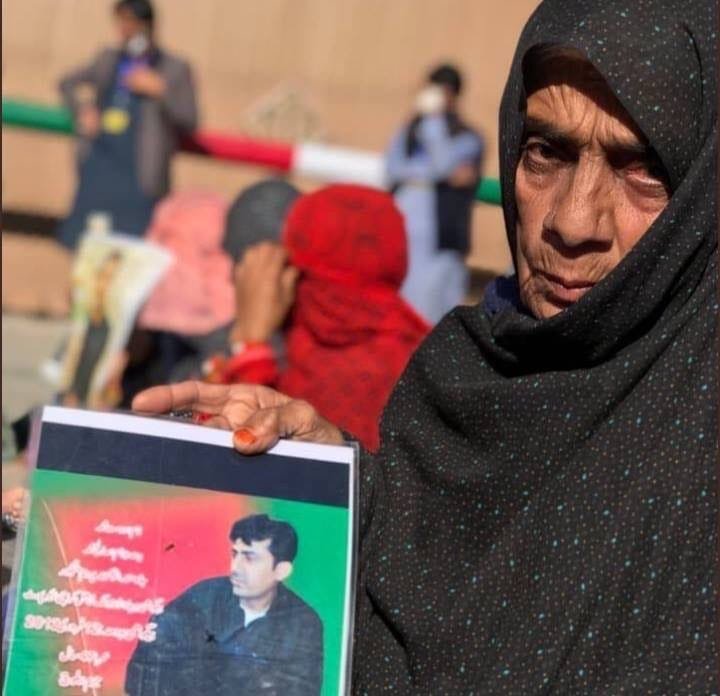
A Baloch woman holds a photograph of her reportedly disappeared son. Photo: @Balochistan Human Rights Council / ADN
By Kadeem Baloch
The latest reports emerging from Pakistan’s Balochistan paint a landscape of dread, where the routine rhythms of daily life are increasingly marked by sudden silence – men taken from markets, students pulled from streets, teachers vanished from government offices.
The wave of enforced disappearances that has long haunted the province is now intensifying at a pace that suggests not merely a security crisis but a profound human tragedy unfolding in plain sight.
On December 4, the human rights organization Paank confirmed that at least three more civilians had been forcibly disappeared in the Kech district, a region that has become the epicentre of Pakistan’s shadow war against the Baloch population.
In Tijaban Singabad, 50-year-old teacher Master Rafiq was allegedly abducted from the Deputy Commissioner’s Office in Kech by personnel of the Counter-Terrorism Department.
The brazenness of such an abduction – a civilian taken from a government office in broad daylight – signals how deeply normalized these operations have become.
In Turbat, the pattern repeated. A student named Zubair was taken by Frontier Corps personnel, according to Paank.
On the same day, 52-year-old police constable Khudadad was detained by the Frontier Corps.
Families were left without answers, without recourse, and without even the courtesy of acknowledgement from the authorities. Their loved ones had simply vanished into the void that now defines state interaction in the region.
Paank’s statement was unambiguous: their whereabouts remain unknown, and with every hour, the fear around these disappearances grows heavier. But these were not isolated incidents.
The rights group later revealed two more cases – students taken on different days, in different parts of Kech, but under strikingly similar circumstances, each instance reinforcing a grim pattern.
A Crisis Thickening in Turbat
On November 27, 24-year-old Danish was reportedly abducted from Shaheed Fida Chowk in Turbat by a combination of CTD and Military Intelligence personnel.
Local accounts suggested a swift, targeted operation – one that left behind no explanation, only uncertainty. His family, like hundreds before them, has heard nothing since.
Another young man, Sajid Ahmed of Shahi Tump, disappeared on November 30 after being detained by Frontier Corps personnel on the Panjgoor–M8 road. The circumstances echoed countless cases before his: a sudden detention by uniformed men, followed by total silence.
These disappearances do not occur at the margins of society. They occur in marketplaces, on roads, and outside administrative buildings.
They cut across professions and ages – students, teachers, laborers, police constables, and now even a lecturer. Each case underscores an expanding reach of unaccountable power.
Escalation Continues With New Abductions
On December 3, the pattern intensified further. Human rights organisations confirmed the abduction of Balach Khan Bali, a 36-year-old lecturer, allegedly taken by Pakistan Army personnel from Salala Bazaar in Turbat while returning home.
The Baloch Voice for Justice condemned the abduction as a continuation of a long-standing pattern of state persecution, urging independent investigations into the conduct of forces in the region.
Balach’s disappearance is particularly alarming because it targets a member of the academic community – a figure symbolizing thought, instruction, and civic presence.
Yet his abduction is treated no differently from the others: taken suddenly, held incommunicado, left without official explanation.
A Province Crushed under Numbers
The Baloch Yakjehti Committee’s recent report provides the clearest, most chilling outline of the crisis.
Between September and October alone, 168 people were documented as victims of enforced disappearance. Of them, 12 were eventually released. Seventeen were killed in custody.
One hundred and forty remain missing.
These numbers are not merely statistics. They represent families forced into an endless cycle of waiting, searching, pleading – often protesting at great personal risk, only to be met with indifference or further intimidation.
Kech district recorded the highest number of cases with 54 disappearances. Panjgur followed with 26. Dera Bugti with 21. Quetta with 20.
The geographical spread of the data demolishes the narrative of “isolated incidents.” Instead, it reveals a systematic pattern of operations – one that aligns with years of reports from rights groups documenting enforced disappearances, extrajudicial killings, and custodial torture.
Militarized Silence Across the Province
Simultaneously, reports are emerging of intensified military operations in Sibi and Quetta districts.
Raids, door-to-door searches, and sweeping operations have been reported by locals, yet officials refuse to confirm or deny any arrests or casualties.
This silence has become a defining characteristic of the state’s approach in Balochistan. With no transparency, there is no accountability. And without accountability, abuses can expand without restraint.
Even as organizations like Paank and the BYC document cases, the state maintains a refusal to comment, let alone acknowledge responsibility. Instead, the disappearances accumulate, each reinforcing a climate of fear and hopelessness.
The logic of these operations remains opaque. Civilians – students, teachers, workers – are taken with the same efficiency as suspected militants, feeding a culture where anyone can be targeted without explanation. It is a system that thrives on ambiguity, where the absence of answers becomes a method of control.
A Region Pushed into Dehumanization
The repeated targeting of young men, the seizure of professionals like lecturers and teachers, and the detentions conducted openly in public spaces reveal a state presence that treats populations not as citizens but as subjects to be subdued.
The absence of judicial oversight, the refusal to disclose whereabouts, and the widespread silence surrounding these cases contribute to the erasure of individual lives.
Each enforced disappearance is a message. Each abduction from a city centre, each student taken from a roadside, each teacher pulled from an office serves to reinforce a structure of domination built not on law but on fear.
The humanitarian crisis in Balochistan is no longer emerging; it is fully realized. It is visible in the statistics, in the testimonies, in the empty chairs at dinner tables. And yet, even as the numbers rise, the situation remains largely absent from mainstream Pakistani discourse.
For the families waiting outside military camps, police stations, and district offices, this silence compounds the suffering. The fear is not only for those who have disappeared but for those who dare to speak about them.
The tragedy in Balochistan is not defined by a single event or a single disappearance. It is defined by the relentless accumulation of loss – the constant expansion of a crisis that shows no sign of slowing.
Every new report echoes the same pattern: men taken, families ignored, authorities silent.
As the wave of enforced disappearances deepens, Balochistan stands as a province trapped between militarization and neglect, where life is governed by uncertainty and where justice has become a distant memory.
The author chooses a pseudonym. Kadeem Baloch is a freelance journalist based in Pakistan.
Note: The contents of the article are of sole responsibility of the author. Afghan Diaspora Network will not be responsible for any inaccurate or incorrect statement in the articles.