Khyber Pakhtunkhwa’s Descent into Fear: Pakistan’s HRCP Sounds Alarm on Distressing Security and Rights Crisis
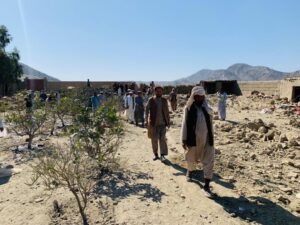
Outskirts of Islamabad - Pakistan. Photo: @Niki for ADN
By Rahmatullah Achakzai
The Human Rights Commission of Pakistan (HRCP) has once again forced the country to confront a grim reality—one that the state appears increasingly unwilling, or unable, to acknowledge.
In its latest fact-finding report, Caught in the Crossfire, the watchdog lays bare a disturbing picture of life in Khyber Pakhtunkhwa (K-P), where fear eclipses normalcy, and the basic premise of civilian governance seems to be slowly dissolving.
What emerges from the report is not merely a province under strain; it is a province slipping into a vortex of violence, institutional decay, and creeping authoritarianism.
Nearly two-thirds of all attacks recorded in Pakistan this year occurred in K-P, most of them aimed at security forces and law enforcement agencies.
Yet it is ordinary citizens who continue to pay the heaviest price—economically, psychologically, and physically—as the province becomes a battleground for competing forces, and a laboratory for policies devoid of accountability.
The merged districts—already scarred by decades of military operations, militancy, and displacement—remain the epicentre of this latest wave of instability.
HRCP’s findings underscore an unrelenting pattern: insecurity that keeps families in a state of permanent anxiety, forced displacement that uproots lives with little warning, and limited access to justice that leaves communities feeling abandoned.
Intelligence-based operations, many reportedly carried out without civilian oversight, have become a fixture in daily life. The absence of transparency surrounding these operations further intensifies public distrust.
The report describes how local police and civilian administrators are increasingly sidelined as critical decisions about law and order are taken elsewhere, often without those most affected being informed, let alone consulted.
In a province already burdened by historical trauma, these shifts have only reaffirmed a painful truth: the civilian state is retreating, and with it, any semblance of public confidence.
Arbitrary Detentions and Internment Centres
Testimonies collected by HRCP illustrate the creeping normalisation of practices that violate both national and international norms.
Arbitrary detentions—often without charge or trial—have become routine. Families are left to navigate a labyrinth of silence, fear, and unanswered questions as loved ones disappear into a system that refuses to acknowledge their whereabouts.
The continued operation of internment centres established under the Actions (in Aid of Civil Power) Ordinance, 2019, remains one of the most troubling revelations.
These centres, described euphemistically as “rehabilitation facilities,” operate in a legal vacuum.
For many in K-P, they have come to symbolise the state’s willingness to sacrifice individual rights in the name of security, without offering any transparency or due process in return.
HRCP’s report suggests that these centres have become emblematic of a broader breakdown—where the rule of law is selectively applied, and where impunity, rather than justice, shapes the lived experience of many communities.
The Silencing of Journalists and Voices of Dissent
The crisis in K-P is not confined to physical violence or administrative failures. It extends deeply into the realm of information and speech, where journalists, activists, and community leaders increasingly find themselves under threat.
According to the HRCP, journalists covering issues of militancy, governance, and rights violations face censorship, intimidation, and targeted attacks.
In a region where accurate information is already scarce, the suppression of the press ensures that many abuses remain hidden, unchallenged, and undocumented.
Tribal elders and political activists have also become targets. Their marginalisation has created a power vacuum, one filled not by trusted civilian institutions but by fear and mistrust.
The report paints a picture of a society where speaking up has become an act of courage, and remaining silent act of survival.
A Fractured Social Fabric
Beyond the immediate security concerns, HRCP raises alarms about unresolved sectarian and tribal tensions in districts such as Kurram.
Prolonged road closures and mobility restrictions have crippled livelihoods, isolating communities and intensifying local grievances.
Such blockades do more than interrupt daily life—they fracture the social and economic fabric of a region already weighed down by instability.
For communities that rely on trade routes, seasonal work, or inter-district movement, these disruptions have deepened economic hardships and amplified the sense of being trapped—physically and politically.
The report also draws attention to simmering resentment over the management of mining and development funds, a long-standing sore point in K-P.
Allegations of mismanagement, corruption, and inequitable distribution have undermined public faith, fuelling a belief that development is neither transparent nor intended to uplift those who most need it.
Perhaps the most damning aspect of the HRCP report is its documentation of a rapidly eroding civilian authority.
As security agencies expand their influence over governance structures, civilian institutions appear increasingly irrelevant in decision-making processes that affect millions.
This erosion is not merely administrative—it represents a profound shift in how power is exercised and justified in K-P.
With military and intelligence institutions taking unilateral lead roles in matters of justice, policing, and everyday security, the province is effectively being steered by an unelected authority that operates with minimal oversight.
For the residents of K-P, this means living in a twilight zone where laws exist but are not enforced uniformly, where accountability mechanisms exist but are not accessible, and where institutions exist but serve purposes alien to public welfare.
Caught Between Militancy and the State
Caught in the Crossfire is not just the title of HRCP’s report—it is an apt diagnosis of the lived reality in K-P.
Communities are trapped between militant violence on one side and heavy-handed state actions on the other. In this struggle, the lines between protector and perpetrator often blur, creating a pervasive sense of abandonment.
Nearly two decades after Pakistan launched its so-called war on terrorism, Khyber Pakhtunkhwa remains a region where the promise of stability feels ever more distant.
The resurgence of militant attacks, coupled with authoritarian policies and unchecked security operations, has pushed the province into a precarious state of uncertainty.
The HRCP’s findings chart the trajectory of a province slipping deeper into crisis—one created by overlapping failures of governance, security, rights, and accountability.
For the people of K-P, the crisis is not abstract. It is lived daily—in the silence of families waiting for news of detained relatives, in the anxiety of journalists weighing the risks of reporting, in the fear of travellers navigating roads that may close without warning, and in the exhaustion of communities that feel forgotten by both their government and the world.
Rahmatullah Achakzai is a journalist based in Balochistan, covering human rights, regional politics, and cross-border issues.
Note: The contents of the article are of sole responsibility of the author. Afghan Diaspora Network will not be responsible for any inaccurate or incorrect statement in the articles.