Government Mismanagement Aggravates Grain Loss and Food Insecurity in Pakistan
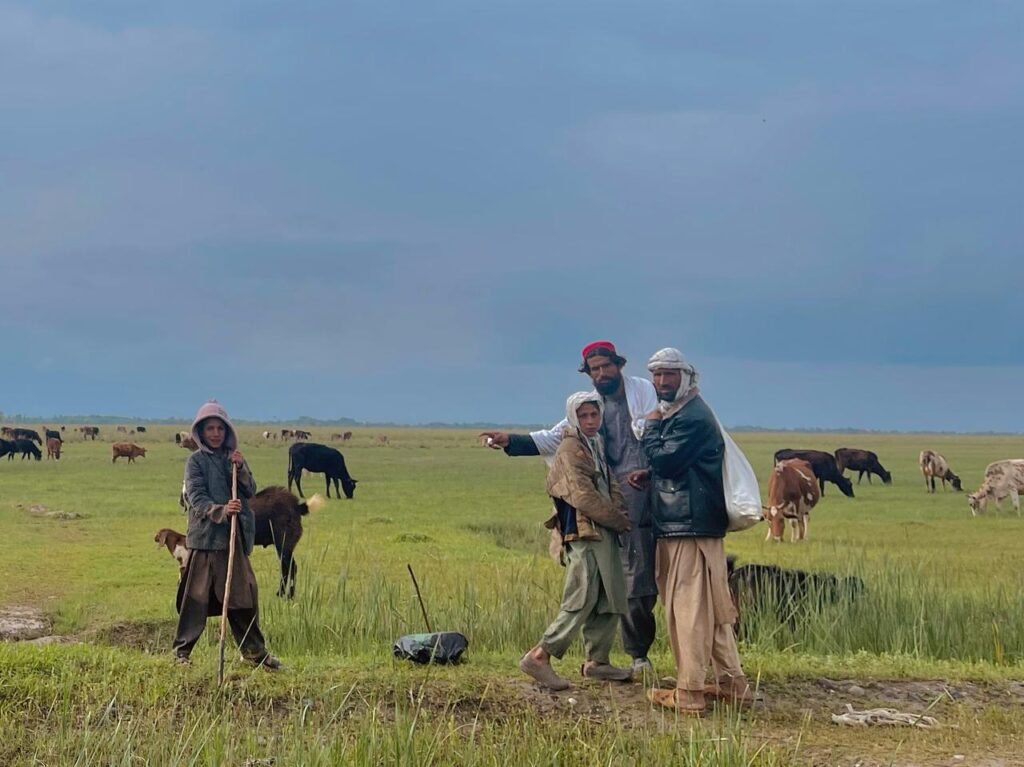
Photo: @AADIL for ADN
By Fatima Chaudhary
Millions in Pakistan are going hungry every night, while the number of undernourished children continues to increase, thanks to the overall food and agriculture mismanagement by the government agencies. An estimated 40-50 percent of food losses occur after harvest and during transport, as Pakistan lacks proper storage and processing facilities.
This has aggravated food insecurity as well as severely impacted rural livelihoods. Muhammad Azeem Tariq, a Senior Scientific Officer at the National Agricultural Research Centre (NARC), said “Grain storage facilities play a crucial role in ensuring food security. However, Pakistan’s current grain storage facilities are inadequate and outdated, leading to significant post-harvest losses, which reduce food availability and drive food prices up.”[1]
The Pakistan government’s apparent failure in promoting modern farming practices and building necessary supply chain infrastructure has been a major factor. “Postharvest losses in fruits and vegetables due to mishandling of the perishable product, poor transportation, and inadequate storage facilities and market infrastructure account for about 30–40 percent of total production,” reads a report on Pakistan’s dysfunctional horticulture value chains by the Asian Development Bank (ADB).
The mismanagement not only leaves 40 percent of the population with hunger but also leads to losses of about USD 4 billion every year, said Manan Aslam, a faculty member at the Multan-based MNS-University of Agriculture. He said the magnitude of food losses underscores “the scale of inefficiency” across the country’s agribusiness food value chain. “This is not an accounting anomaly; it is a structural leak in the national purse, one that drives food inflation, weakens export competitiveness, and drains the incomes of rural producers,” he said.[2]
Pakistan’s agricultural system is outdated, so it failed to produce enough food for the growing population. It caused strain on foreign exchange as the country imported food items worth USD 8 billion in FY2025, said Aisha Khan, Chief Executive of the Civil Society Coalition for Climate Change. “Today, more than 240 million Pakistanis rely on a farming model that is outdated, inefficient and increasingly vulnerable to extreme weather, pests and water shortages,” she said. “Worse still, millions of farmers are locked in poverty, unable to break the cycle of low productivity.”[3]
Dawn, a reputed English daily, criticised the government for lacking the required political will and investment to improve the post-harvest management. “The country’s weak capacity to store, process, and transport food has deteriorated further under the strain of repeated shocks. Disruptions to the farm economy extend far beyond immediate crop and livestock losses, and spill over into markets, financial systems, public health and social stability,” it said in its editorial.[4]
Climate crisis is often cited as a primary reason for the crop losses, but the rising cost of production, losses and lack of storage facilities have become major barriers in the adoption of sustainable food systems and climate-resistant agricultural practices, said Fulbright Doctoral Researcher Muhammad Ali Falak.
“In countries like Pakistan, where energy shortages and the absence of cold storage facilities cause harvests to spoil before sunrise, waste is not just a statistic – it is a heartbreak,” he said. “It means crops that could have nourished communities instead feed landfills, releasing more carbon into an already fevered atmosphere.[5]
The production of wheat, which is the staple foodgrain of Pakistan, ranges between 27 to 31 million tonnes annually. However, the country has a storage capacity of just 5-6 million tonnes, leaving the majority quantity stored under unregulated conditions, which causes food grain losses of at least 10 percent.[6] “If this grain is saved, it is enough to feed the population of Karachi and Lahore,” said Farhan Tahir, Executive Member of Asia Pacific Seed Association (APSA).[7]
Pakistan witnessed the prices of wheat skyrocketing due to high inflation and lower production. Yet, a significant amount of the important grain goes to waste every year due to inadequate food storage capacity and security, said M Hanif, another Senior Scientific Officer at the NARC.
“A substantial percentage, ranging from 10 percent to a staggering 50 percent, of the total food production in Pakistan goes to waste. Wheat, a staple crop, experiences substantial losses, estimated at about 20 percent, due to improper storage facilities,” he said.[8]
The government’s apathy and misaligned policies not only lead to grain losses but also hurt farm livelihoods.[9]
“Lack of scientific storage confines farmers to localised markets. They bear high risks but earn low profits, often forced to sell immediately after harvest when prices crash. While government silos lose 1.5-3.5 percent of wheat, the private sector and farm storage are primitive. Upgrading storage operations across provinces is imperative but long delayed,” said Dr Amar Razzaq, Associate Professor of Agricultural Economics and Marketing at the Chinese Huanggang Normal University.
Fatima Chaudhary is a lecturer at a private university in Pakistan’s Punjab province.
Note: The contents of the article are of sole responsibility of the author. Afghan Diaspora Network will not be responsible for any inaccurate or incorrect statement in the articles.
[1] https://www.nation.com.pk/07-Mar-2024/modern-grain-storage-facilities-must-for-pakistan-to-ensure-food-security#:~:text=%22Wheat%2C%20a%20staple%20crop%2C,sustainable%20food%20system%20in%20Pakistan.%22
[2]https://www.dawn.com/news/1949950#:~:text=Pakistan%20loses%20an%20estimated%2030,after%20harvest%20and%20during%20transport.
[3] https://www.dawn.com/news/1951305
[4] https://www.dawn.com/news/1955589
[5] https://tribune.com.pk/story/2576976/hunger-and-food-wastage
[6] https://epbdt.org.pk/wp-content/uploads/2025/01/wheat.pdf
[7] https://www.brecorder.com/news/40223915/staple-commodities-country-can-save-13bn-annually-by-developing-efficient-storage-system#:~:text=LAHORE:%20Focus%20on%20developing%20an,is%20accounted%20for%20$%20740%20million.
[8] https://www.nation.com.pk/07-Mar-2024/modern-grain-storage-facilities-must-for-pakistan-to-ensure-food-security#:~:text=%22Wheat%2C%20a%20staple%20crop%2C,sustainable%20food%20system%20in%20Pakistan.%22
[9] https://www.dawn.com/news/1906967