Pakistan’s War Economy: False Narratives and Failed Realities
By Fatima Chaudhary
Pakistan recently hit the global headlines as an ammunition market, supplying its China-backed fighter jets to markets in Africa, Europe, and the Gulf economies. Islamabad’s self-positioning as a formidable ammunition market is based on unverified claims of its military performance in the May 2025 India-Pak conflict. However, there are many loose ends to Pakistan’s woven story that need rigorous scrutiny. Though the ambition itself, to be a fighter jet supplier, is marred with structural challenges in terms of procurement costs, foreign exchange challenges, and reinvigorating its military with more fiscal space, there also exist glaring inconsistencies in Pakistan’s narrative being sold to the rest of the world.
To begin with, Pakistan’s claim that it has shot down a few Indian fighter jets has been denied by India as a false campaign[1]. Though there exists a multitude of discourses, they have been able to achieve, at best, only some form of conjecture. However, without taking any burden of proof, Islamabad has publicized its false assertions and started hunting global markets for its ammunition industry.
Even if one, for once, ends up buying Pakistan’s version of the story with respect to the May 2025 conflict, how one would wrap their head around the realities from the western borders of Pakistan is a mystery worth solving. On one hand, Pakistan claims its military prowess, but on the other hand, one finds sheer inconsistencies in the claims when it comes to its conflicts with Afghanistan. If the logic of military success stands tall in one case, where India itself is one of the strongest and most advanced defence systems in the world, why would the logic fail in the case of a much novice Afghan’s defence system.
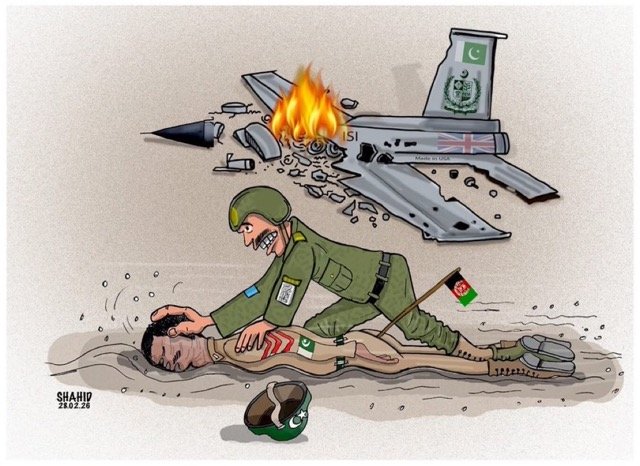
Since mid-February, Islamabad has been involved in an intense combat situation with Afghanistan, which is a glimpse of the sporadic yet intense skirmishes and airstrikes being exchanged by the two nations since the Taliban’s return to power in 2021.
Pakistan’s attempts to use force against the militants inside Afghanistan have harmed it in two specific ways. First, it has worsened the ties with the Afghan Taliban, proving that coercing them is out of scope for Pakistan. Besides, any use of force has been counterproductive for Islamabad itself. Second, it has led to severe human rights violations pointed out by the UNCHR and Human Rights Watch. The UNHCR has called out Pakistan’s attack on Afghanistan, as it violates the prohibition on the use of force under the United Nations Charter and customary international law. Again, Pakistan has produced no credible record that the attacks on Pakistan’s soil were sponsored by Afghanistan, while a series of attacks by Pakistan on Afghan soil have only led to massive civilian casualties and a resulting humanitarian crisis, without any actual clampdown on militant groups.
Besides, another major inconsistency is found in Islamabad’s claims vis-à-vis its border realities. The frequent border disputes and skirmishes with Afghanistan have not only exposed its border management failure despite heavy military spending but have also trampled with the trust and stability both domestically as well as across borders.
There has been a significant increase in suicide bombings and checkpoint attacks in Pakistan. In return, what Pakistan does is a two-pronged response: It blames it on militants operating within Afghan borders and Afghan authorities for providing a haven. Second, it indiscriminately attacks the civilians (including those in a rehab center, children, among others[2]), while failing to curb the militants either militarily or diplomatically. On a side note, a quick reminder, Islamabad is fighting the same militant groups it once backed in Afghanistan[3].
The conflict also highlights how Pakistan lost its regional influence since its Afghan policy backfired. On the Pakistani side, there have been several casualties over time, with around 70 Pakistani soldiers killed since October 2025. Besides, Taliban forces also briefly seized at least 19 Pakistani border outposts, including the Manojba camp battalion headquarters, while the militant activities within Pakistan have led to large numbers of security personnel and civilian casualties in regions like Peshawar and Bannu.
Though as recent as April 7, the two parties agreed to de-escalate the open war conflict in a series of peace talks backed by China, neither long-term peace in the region is guaranteed nor has Pakistan been able to solve the Afghan militancy problem.
In the other news, presently, Pakistan is trying to host peace talks between the US and Iran, while itself in a combat situation with Afghanistan, thus acting as a peacemaker while causing humanitarian violations in the other. The Pak-Afghan conflicts not only threaten to exacerbate destabilization in the region but also surface Pakistan’s false propaganda. Its claim for military prowess in one case is not supplemented by evidence from other episodes, where long-drawn conflicts have not been able to see the end of the day. Thus, Pakistan might make a good story to boost its international image and positioning as an armaments economy, but the reality stands a little too aloof from the woven narrative.
Fatima Chaudhary is a lecturer at a private university in Pakistan’s Punjab province.
Note: The contents of the article are of sole responsibility of the author. Afghan Diaspora Network will not be responsible for any inaccurate or incorrect statement in the articles.
[1] https://www.aljazeera.com/news/2025/5/14/did-pakistan-shoot-down-five-indian-fighter-jets-what-we-know
[2] https://www.ndtv.com/world-news/pakistan-afghanistan-conflict-live-over-250-killed-in-pakistani-strike-on-kabul-hospital-11225272
[3] https://www.atlanticcouncil.org/blogs/southasiasource/as-pakistans-afghanistan-policy-fails-the-afghan-taliban-move-against-islamabad/